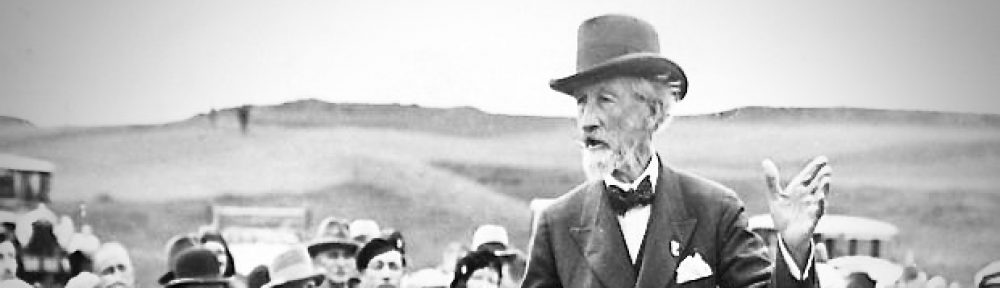
It’s been a long time since I last posted here, nearly two years in fact. I’ve been busy promoting my biography, Don Roberto: The Adventure of Being Cunninghame Graham, and building a programme of talks and events, plus a website and newsletter, for the Cunninghame Graham Society. And things have been pretty quiet on the constitutional front.
With four weeks to go now until the May election, there’s movement again, although on some fronts nothing at all has changed. I posted this piece today on my other blog site, A Few Kind Words, and am re-posting it here. (You can follow A Few Kind Words on WordPress or on Substack, depending on your preference.)
“It hurts to hear your country being run down, your government traduced, every single day. It’s exhausting and disheartening, especially when you know that many of your own countrymen and women believe what they hear.”
This time five years ago, in the weeks leading up to the Scottish Parliament elections of May 2021, I made a series of short videos (see below) arguing the case for an independent Scotland.
I felt driven to it, more than anything else, by the lack of information – and misinformation – to be had from the mainstream media about the realities of contemporary Scotland: its economic, social and cultural fabric; the factors that distinguish it from its larger, dominant neighbour; and the true nature of its potential were it to be unconstrained by the union.
The first of these videos was really a howl of frustration. I had no particular aim in mind, just the need to express something. When, to my amazement, it received several thousand views, I kept on going with a video each week until the election.
Looking back now, as the same elections come round again on 7 May, I can see that my arguments were underpinned by two very basic principles. Firstly, that it is perfectly normal for a person to wish for their country to be governed on its own soil, by its own people, for its own people. This is not an aberration of judgement, as we’re often told.
Secondly, that Scotland, with a mature economy, long-established institutions, deep cultural traditions and its own set of social values, is a distinct and viable nation. It’s not perfect, it has flaws in its systems, its government, its national character, like any other nation. But it is more than capable of managing its own affairs.
I won’t rehearse the arguments for independence again here. The world may have changed greatly in the last five years, but the fundamentals haven’t. Neither, sadly, has the frustration. We Scots find ourselves still in the extraordinary position that slightly over fifty percent of us (according to most recent polls) hold views that are almost entirely unrepresented in the mainstream media.
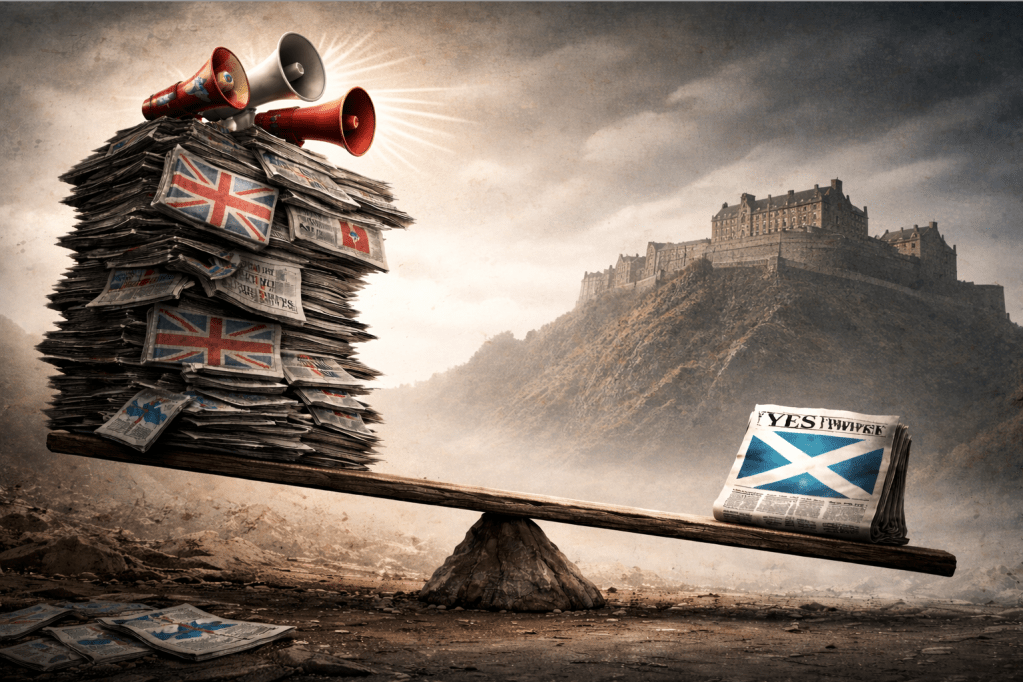
Imagine this in any other country in the world – an existential national issue that is barely mentioned, let alone seriously debated, by that country’s fourth estate. Yet here in Scotland, where more than half of us want our country to be independent, it’s as if there’s a media blackout on anything that might appear to support that desire.
If you’re not familiar with the Scottish media landscape, there are two long-established daily newspapers, The Herald (Glasgow) and The Scotsman (Edinburgh). At the time of the 2014 independence referendum both supported the union. Today they continue to do so.
There is one alternative voice, The National, launched in 2014 by the union-supporting owners of The Herald in an unashamedly commercial move to exploit the readership potential of the independence movement. Today The National continues valiantly to champion the cause but does not have a wide circulation.
BBC Scotland’s coverage is worse than abysmal, caricatured as offering a relentless diet of ‘fitba and murrrders’. While the BBC as an institution is seen increasingly in Scotland as the British (for which read English) state broadcaster (for which read propagandist).
Look in the English broadsheets, The Times, The Telegraph, The Guardian, not to mention the tabloids, listen to ITV, Sky, even Channel Four, for any serious, let alone positive, presentation of the issue. You will be disappointed.
On a good day in the British media the story will be that Scotland is chronically mismanaged; on a bad one, that it is an irredeemable basket case, ‘too wee, too poor, too stupid’ to look after itself.
It hurts to hear your country being run down, your government traduced, every single day. It’s exhausting and disheartening, especially when you know that many of your own countrymen and women believe what they hear.
It is just a narrative, a story – and a false one at that, which half of Scotland’s voting population wholeheartedly reject. But while it remains controlled by the mainstream media, it continues to work for the other half, who have heard it for so long that they can’t be blamed for not questioning the truth of it.
Those of us who support independence, and have to seek our news and information ‘off piste’ as it were, are all too well aware of the arguments in favour of the union (which today seem vanishingly few). But those who consume only the mainstream media will scarcely ever hear an argument in favour of independence.
On any national issue, let alone such a serious one, it’s a grotesque imbalance, and one that has everything to do with who owns the press. Its consequence is that we have to pursue our cause with one hand tied behind our backs.
It’s a sair fecht, but I find some consolation in the thought that, despite the controlling narrative, well over two million fellow Scots feel the same way as I do.
 Don Roberto & Me